
The marketing landscape is shifting faster than most businesses can track. At A-Squared Marketing, we’ve been watching this one closely: OpenAI officially launched contextual ads inside ChatGPT on February 9, 2026. This isn’t a rumor or a roadmap item. It’s live. And it’s already reaching hundreds of millions of users. The question is no longer whether AI advertising is coming — it’s whether your business is positioned to take advantage of it when the opportunity opens up.
This post breaks down what ChatGPT ads actually are, how they work, who they reach, and what you can do right now to stay ahead of the curve.
What Are ChatGPT Contextual Ads?
ChatGPT ads are a new form of advertising that appears inside AI-generated conversations. Unlike traditional ads that follow you around the internet based on your browsing history, these ads are triggered by the intent of your current conversation. If someone asks ChatGPT for help choosing accounting software, an ad for a relevant platform might appear at the bottom of that response. The ad is clearly labeled as “Sponsored” and is visually separated from the AI’s answer. It shows up after the response, not inside it.
This is a meaningful distinction. The ad doesn’t change what ChatGPT says. It sits alongside the answer, not within it.
Who Sees ChatGPT Ads — and Who Doesn’t?
Not every ChatGPT user sees ads. OpenAI has structured its ad rollout by subscription tier. Ads currently appear for users on the free plan and the $8/month ChatGPT Go tier. Users on Plus, Pro, Business, Enterprise, and Edu plans continue to have an ad-free experience.
Ads are also restricted to logged-in adult users. OpenAI does not serve ads to anyone it identifies or predicts to be under 18. Users can also control ad personalization settings, including the ability to turn off personalization or clear their ad data entirely.
The initial rollout targeted U.S. users. By May 2026, OpenAI began expanding the pilot to the United Kingdom, Mexico, Brazil, Japan, and South Korea.
How Is This Different from Google or Meta Advertising?
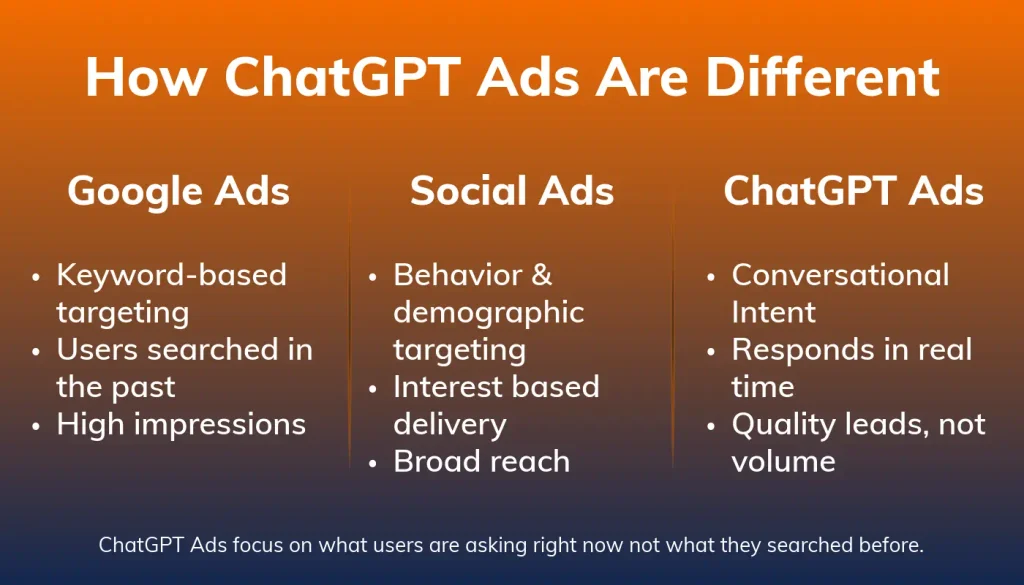
This is the question every marketer should be asking. The difference comes down to intent signal quality.
On Google, users type fragmented keywords. On Meta, ads are served based on demographic data and past behavior. On ChatGPT, a user might type: “I run a 12-person landscaping company, and I’m looking for software to manage scheduling and invoicing. What should I use?” That’s not a keyword. That’s a full picture of a buyer’s situation, need, and decision stage, delivered in real time.
ChatGPT ads match to that conversation context, not to a keyword bid or an audience profile. For businesses that sell complex or high-consideration products and services, this is a meaningfully different kind of placement. The user isn’t passively scrolling. They’re actively working through a decision.
Will Ads Change What ChatGPT Says?
This is the trust question, and it matters. OpenAI has been direct: ads do not influence the answers ChatGPT gives. The AI generates its response based entirely on what’s most helpful to the user. The advertising system only activates after that response is complete.
Advertisers do not have access to user conversations, chat history, or personal details. They only receive aggregate performance data, things like impressions and clicks. OpenAI has also committed to never selling user data to advertisers.
This separation matters for advertisers, too. The trust users place in ChatGPT’s answers is what makes those intent signals valuable in the first place. Compromising that trust would undermine the entire platform.
What Kind of Businesses Are Best Positioned to Benefit?
Not every business category is equally suited to ChatGPT ads right now. The platform rewards businesses where the buying decision is complex and the user is actively researching. Categories that are best positioned include B2B software and services, professional services, education, premium consumer goods, and local service businesses where users are comparing options.
Businesses that rely on impulse purchases or broad brand awareness campaigns will find the platform less effective at this stage. The format is built for intent-rich moments, not passive reach.
It’s also worth noting that certain categories are currently restricted. These include healthcare, financial services, legal services, gambling, alcohol, and political content. OpenAI has signaled that some of these restrictions may evolve with more selective contextual rules, but no timeline has been confirmed.
Does This Affect Your Current Marketing Strategy?
The short answer is: not immediately, but you should be preparing now.
ChatGPT ads are still in an early pilot phase. The self-serve platform opened in May 2026, with CPC (Cost-Per-Click) and CPM (Cost-Per-Thousand) bidding options. But full access is not yet available in all markets, and the format options are still limited. This is not the time to pull budget from what’s working and redirect it here.
What it does change is how you think about content and visibility. Users are increasingly turning to AI to research, compare, and make decisions — instead of clicking through a list of search results. That means your brand’s presence inside AI conversations matters, even before you run a single ad. Strong, clear messaging. Accurate business listings. Content that answers real questions with real specificity. These are the foundations that help your business show up in AI-generated answers — and they make any future ad investment more effective.
What Can You Do Right Now to Prepare?
You don’t need to be an early adopter to start getting ready. Here’s where to focus.
1. Sharpen Your Messaging
ChatGPT ads reward specific, intent-matched offers. Generic brand messaging won’t perform well in a conversational context. Know exactly what problem you solve, for whom, and why you’re the right choice. If your current messaging is vague or broad, this is the right time to tighten it.
2. Build Your Content Foundation
AI platforms pull from content that clearly answers real questions. Blog posts, FAQs, service pages, and case studies that speak directly to how users make decisions are the building blocks of AI visibility. Think about the questions your best customers ask before they buy, and make sure you have clear, useful answers published somewhere they can be found.
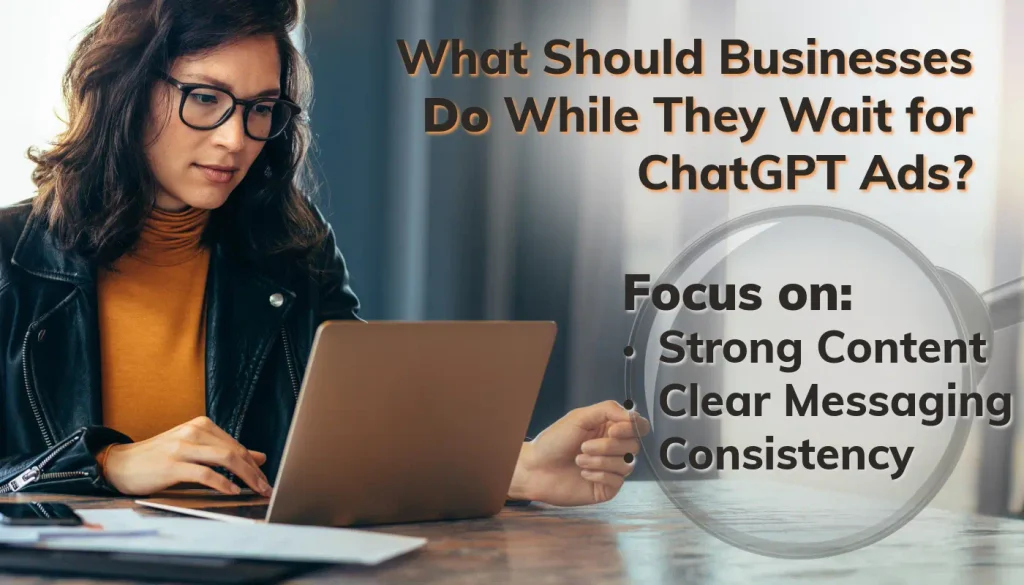
3. Audit Your Digital Presence
Your website, Google Business Profile, and any directory listings should be accurate, complete, and consistent. AI systems use this information to evaluate and represent your business. Gaps or inconsistencies hurt your credibility in both organic AI results and paid placements.
4. Watch the Platform
OpenAI’s advertiser page is the best place to monitor updates and express interest in participating. The self-serve platform is expanding, and businesses that stay informed will be first to test when access opens up in their category or region.
Is This a Channel Worth Investing In Right Now?
That depends on your category, your market, and your existing marketing foundation.
If you’re in a high-consideration category: professional services, B2B, education, or local services where users are actively comparing options, this is worth watching closely and preparing for. The intent signals available in ChatGPT conversations are unlike anything currently available on traditional ad platforms.
If you’re in a restricted category or rely on broad awareness campaigns, the ROI case isn’t there yet. The platform is still being built. Formats are limited. Geographic availability is still expanding.
The honest read: the foundation is real enough to plan around. It is not yet mature enough to be a primary channel for most businesses. The businesses that invest in preparation now — sharper messaging, stronger content, cleaner digital presence — will be better positioned when the platform does open fully.
The Bottom Line
ChatGPT ads are not a trend to watch from a distance. They’re live, they’re expanding, and they represent a genuinely new kind of advertising channel, one built around conversational intent rather than keywords or behavioral data. The opportunity is real. So is the learning curve.
The businesses that will get the most out of this channel are the ones that start preparing before the door fully opens. That means getting your messaging right, your content in order, and your digital presence clean. Not because ChatGPT ads demand it, but because those are the fundamentals that drive results on every channel, including the ones that already exist.
Not sure how AI advertising fits your strategy? Let’s find out together. Book your free Marketing Accelerator Strategy Session.